The Development of Picture Frames
Early Use Of Gilded frames
Continued Use of Gold: Gilded items are known from early history. As Christianity gained prominence throughout Europe the practice continued. Gilding continued to be used extensively in religious buildings. This was seen in the building of churches and cathedrals. Gold only was good enough for God. It was notably expressed in the altar piece. Here the framework of wood was constructed first with the paintings on wooden panels inserted after.
Construction: The framework was often a complicated, architectural piece, carved and gilded. The paintings were made to fit the open spaces. Sometimes sections of the paintings background was gilded and profusely decorated. Raised gesso was used along with ‘sgraffito,’ or scratched decoration, carved gesso and decorative, punched work. Sometimes the gilding was painted over then a design carefully scratched out from the paint. This revealed the gilding underneath creating a rich pattern.

Altar Piece. Duccio di Buoninsegna, Maesta 1311 Museo del Opera Metropolitana del Duomo, Siena, Italy.
Many altar pieces were broken up into individual parts then sold all over the world. The pieces often as panels needed framing. Some retained their original frame or parts of the frame. This is a rare example of an intact altar piece.
Enter The Easel Painting
A New Order: The Renaissance and the rise of the merchant class saw the birth of the easel painting. The term generally identifies works intended to be hung on a wall and executed on an easel. Initially painted on wood panels a frame was needed to hang them for two reasons. One was mechanical, a physical means to carry out the hanging. The other to give an edge, a border to the painting to separate it from the wall behind. The goal was to attract and confine the eye to the painting.
A New Subject: Religious subjects for private clients continued to be the object of some paintings. Other themes were taken from Greek mythology. Now portraits of individuals wealthy enough to pay for them came on the scene. This radically changed the use of the frame. Now frames were made to fit the picture rather than the picture made to fit the frame.
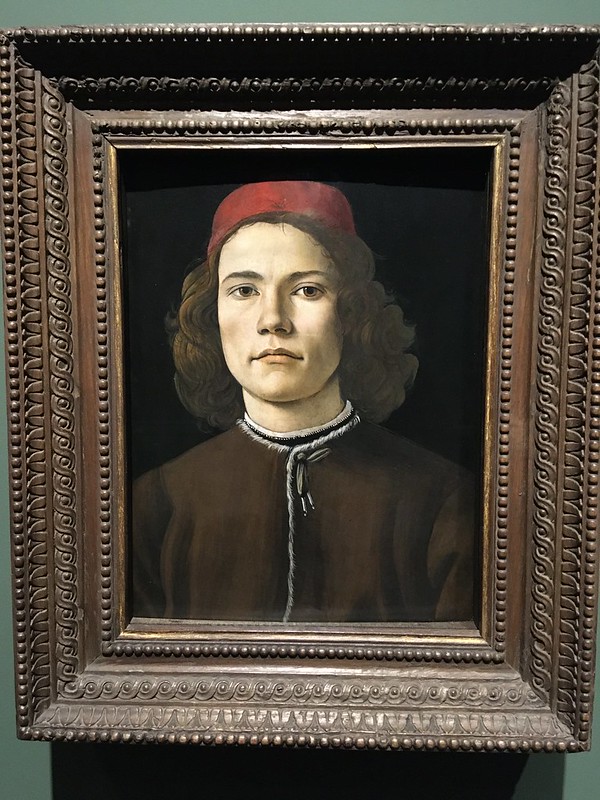
Portrait of a young Man by Alessandro di Mariana Filipepi (Botticelli, Little Barrel).
An early example of a personal portrait. The sitter is unknown. It is not known why Botticelli painted it. It is speculated to be a commission by the young man’s family. It has also been proposed the sitter was a pupil of Botticelli. He may have painted it purely as an exercise. Whatever the reason it shows a departure from mainstream painting. That of allegorical scenes from mythology or religious depictions.
A Notion Continued
Continuing the Old: The notion continued though, that the frame needed to be gilded. Furthermore, the more elaborate, richly decorated and showy finish was considered desirable. This bespoke the skill of the craftsman involved in the frames manufacture. It put them on a level as much as or more than that of the artist. It tended to draw attention away from the painting onto the frame.
The Mistaken Idea: In this, it defeated a principal use of the frame. The purpose was to draw attention to the picture and not onto the frame itself. The frame also became a way of broadcasting the painting owner’s success. The more extravagant and richly decorated the more it expressed the prestige of the owner.
Straying From The Notion
The Enlightened Idea: There were framers who countered this tendency by producing frames with more subdued finishes. These were found extensively in Italy. They used passages of gilding and paintwork and unfinished, plain wood. This had the effect of lessening the intensity of a completely gilded surface. It sometimes allowed the eye a period of rest. It contained the brightness of the gold or gave relief from gilding all together.
Enlightened Efforts: The Dutch turned to using black, ebonised or lacquered finishes. This was as much a Puritanical reaction to ostentation as aesthetic. A notable diversion to bright gilding was seen in the nineteenth century in England. Members of The Pre-Raphaelite Brotherhood departed from gessoed, bright gold. They turned to gilding directly onto wood itself, usually oak. The artist James McNeil Whistler used this technique in his frames. It was an already established practice in architecture. The open pores of the oak broke up the surface of the gilding. This gave a softer, mat finish.
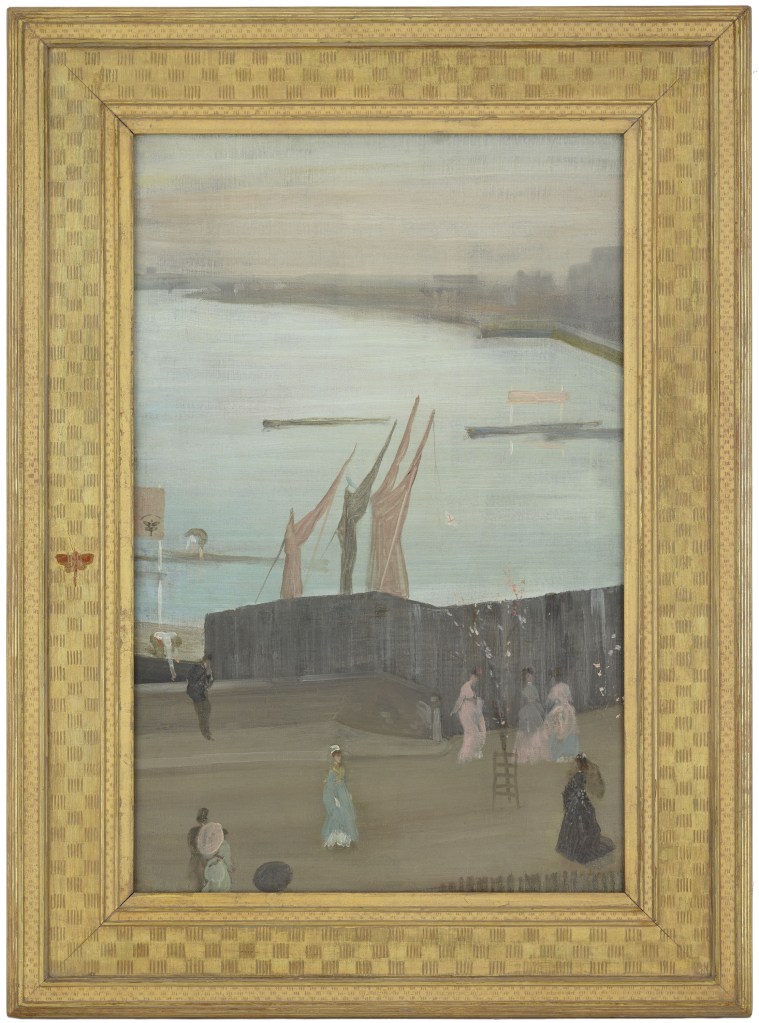
Frame designed by James McNeil Whistler.
The profile, or profiles, are executed in carved, gilded oak. Of his frames Whistler wrote: ‘You will notice and meet with opposition that my frames I have designed as carefully as my pictures-and thus they form as important a part as any of the rest of the work-carrying on the particular harmony throughout-This is of course entirely original with me and has never been done before.’ Whistler wanted to get away from ‘…the mean old abomination of years ago.’ He hoped to do this by using gilding on oak for a softer finish. In this he failed. He continued the practice of wide, elaborate and inappropriate colouring. A smaller frame echoing the cool, pastel tones of the picture would have been better. To his credit he recognized the artist’s role in framing their pictures.
The Persistence Of Notion
The Persistence of Error: Mainstream framing continued with highly decorated, brightly gilded frames. It also followed fashion through Baroque, Rocco to Neo-classical, Empire and such trends as Barbizone. This persistence of the notion had the effect of often ignoring the needs of the picture.
From Bad to Worse: During the nineteenth century a development occurred which had a detrimental effect on picture framing. This was the use of paste decoration. It was to replace hand carving. A matrix was made of the desired design carved into a block of fruit wood. This was then used over and over again. Paste was cast from the matrix and glued onto the gessoed frame while still pliable. After that the paste hardened and resembled wood. It represented a form of mass production.
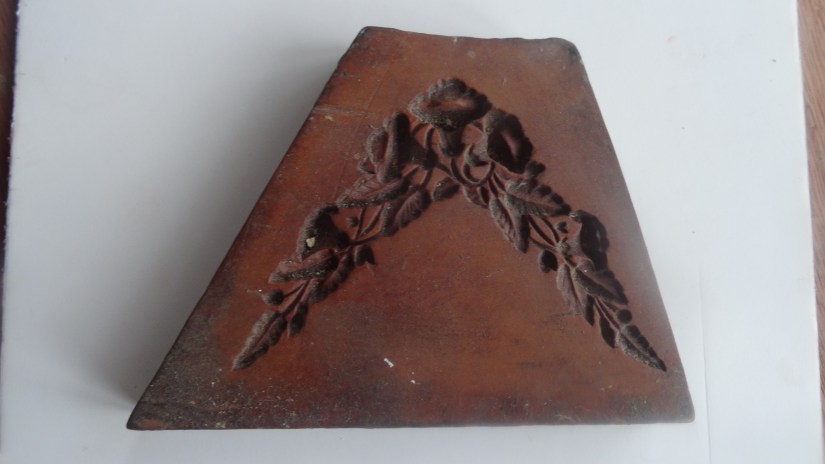

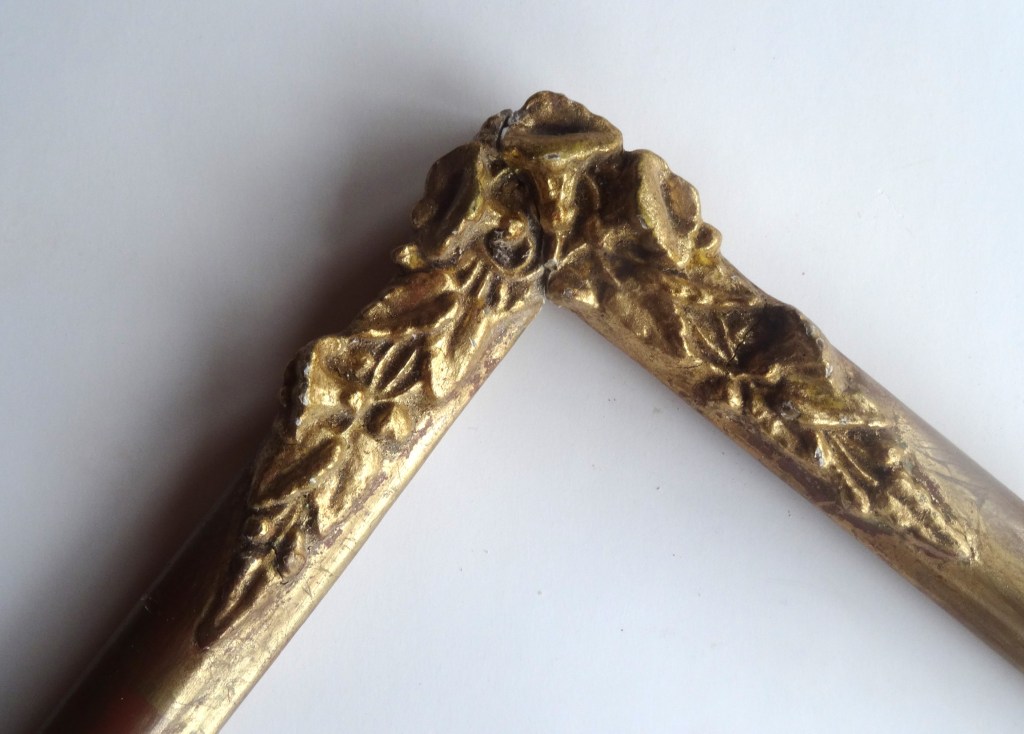
The top image is a matrix. The middle image a paste cast taken from the matrix. The bottom image is the cast applied to a frame section and gilded.
The first step was to make a clay model of the decoration. Next a plaster mould was made of the clay model. This then served as a guide to the wood-carver to follow. The wood block used here is fruit wood, most likely pear. It has a tight grain necessary for incised carving. This is carving of the highest quality. Paste decoration was known to the Egyptians in at least the 1st century CE. It was applied to linen binding of mummified objects. It was used to represent face, hands and feet and was painted. Even on linen it had a tendency to crack and break. A later use was in Italy on dowry boxes as small, raised decoration.
The Legacy Of The Paste Frame
Nurturing Error: The paste frame imposed a design on the frame which was not unique for the picture. It continued the promotion of a large, brightly, gilded frame. The paste needed to be covered with a finish. It also persisted in the idea a frame ought to be highly decorated. It lead to the production of over large, over decorated and over bright frames. This had the effect of drawing attention to the frame and away from the picture.
Inbuilt Faults: Furthermore, the paste used is not hygroscopic. It does not absorb or exude moisture as does wood. The wood in a frame is subject to humidity. It expands and contracts over time through changing, atmospheric moisture levels. This often cracks the paste. Pieces work loose and fall off the frame.

Barbizone Paste Frame showing repairs where pieces of paste decoration have fallen off.
This process will continue due to the inherent fault with paste. In some galleries it is a daily round picking up pieces that have fallen off. These are then given to technicians to glue back onto the frames. Any loss is unsightly. It is not cost effective to repair extensive cracking and loss on some frames.
Modern Attitudes To Picture Framing
Differences: There is a wide difference of opinion among those responsible for the framing of pictures. Some advocate the frame does not matter and is of no importance. They support under-framed pictures. Others with an opposite view tend to over-framed paintings. They advocate and use elaborate, gilded frames. These have a similar effect to the under-framing. They are just as inappropriate. Either way is to deny a principal reason for the frame. That is to attract attention to the picture.
Basics: A poorly or inappropriately framed picture will defeat this goal. A brightly gilded frame on a softly coloured painting will overpower it. A frame that does not relate to the painting will disturb the onlooker’s eye subconsciously. It will cause them to look away when it should cause them to look in.
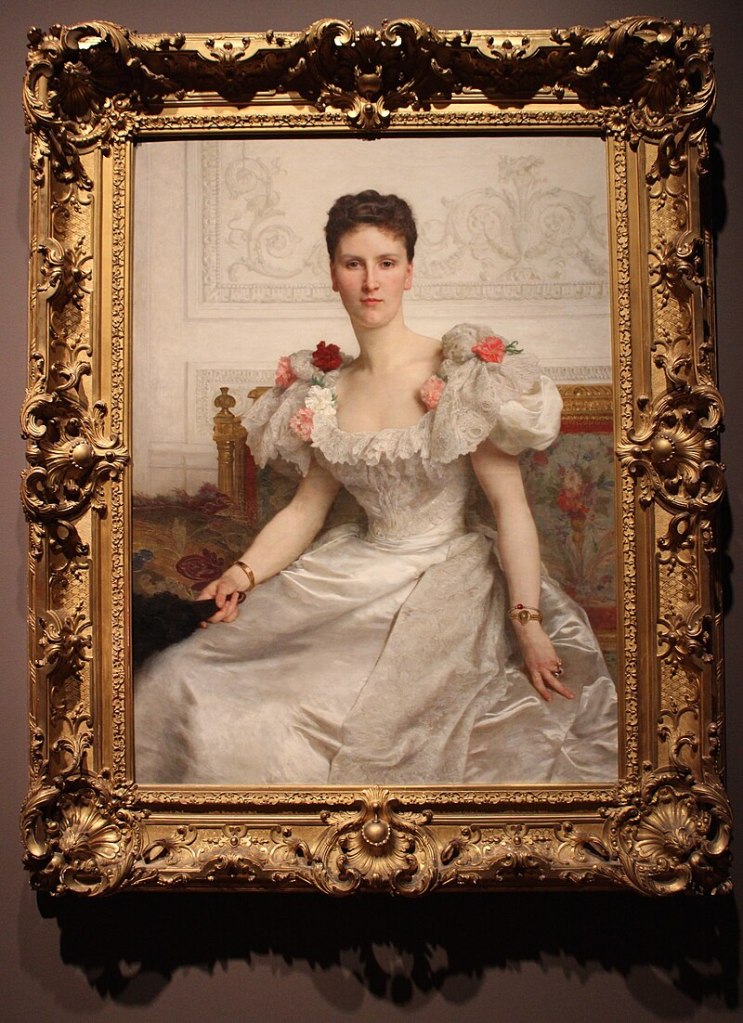
William-Adolphe Bouguereau. La Comptesse de Cambuceres.
An example of a grossly over-framed painting according to the fashion of the time. It is a beautiful, hand crafted frame but it shouts opulence. Brightly gilded and elaborate it does not relate to the painting in any way. The portrait softly coloured needs a quiet, softly coloured frame to compliment it. A cassette or similar frame would be more appropriate. An ivory or off white, center panel and frosted gilding moulding to the outer and inner edge would be better. It would echo the soft colouring of the picture and the gentle, feminine theme. The softened gilding would add all the touch of brightness necessary.
Mass Produced Picture Moulding In Lengths
Bypassing Craftsmanship: With the advancement of industry came the means to make picture moulding in lengths. It was accomplished through the invention of profiling machinery. The lengths were finished in the factory for assembly by the picture framer. It is fine for things like prints, photographs, keepsake items and personal memorabilia. Where an individual, hand crafted item is concerned it is inappropriate.
The Pursuit of Craftsmanship: The painting is a handcrafted item. The theme of handcraft should be continued in the frame. The best person to do this is the artist himself. This is not a new idea. Members of the Taos Community in New Mexico like Irvine Couse are an example. Nikoli Fechin who was a trained wood-carver is another. In Boston the Prendergast Brothers of the Hudson River School made frames for their own paintings.
Individuality: This conforms to the principles of the Arts and Crafts Movement which encourages individual skills. It also encourages a more enlightened consideration to the appropriate frame. Here the artist needs to be well informed on the principles of framing. It will add a new dimension to their oeuvre.
The philosophy of picture framing expressed in this blog is radical. It calls into question much that has gone before. It does the same for much that is current in picture framing today. The Impressionist Movement was a huge step forward in picture making. Unfortunately it was not accompanied with an equivalent step forward in appropriate framing. Die hard, academic tradition often holds sway. That is no reason to discount the philosophy expressed here without due consideration. No more than the radical philosophy of the Impressionists be discounted. With the choice of framed paintings displayed in this gallery the case rests.
 Rodney Ison Gallery